
To cancel one email subscription in Gmail, open a message from the sender and click Unsubscribe next to their name. To cancel several, open More → Manage subscriptions in Gmail on the web. To cancel dozens, scan the inbox for subscription senders and send the requests in batches instead of opening each message by hand.
I'm Alec Lindsay. I founded the Gmail Unsubscribe Chrome extension, and about 104,000 people have installed it. The single most useful thing I can tell you about canceling a subscription is that the request leaves Gmail and lands with the sender, so Gmail cannot promise it worked. Roughly a third of the attempts we measure hit a sender with no working unsubscribe mechanism at all. Knowing which third is the whole game.
"Cancel email" means two different things
People search this phrase for two unrelated jobs, so it is worth splitting them before you click anything.
- Cancel a subscription: tell a company to stop sending you a recurring newsletter or promotion. That is this page.
- Cancel a message you just sent: pull back an email during Gmail's Undo Send window. That is a different feature with a different deadline, covered in how to unsend an email in Gmail.
One more distinction that trips people up: canceling changes what arrives tomorrow, archiving changes what you can see today. Neither does the other's job.
Cancel one subscription
Start with the sender's own process. It gives you the clearest confirmation and does not hand your inbox to anything new.
- Open a recent message from that sender. Check the name, the address, and the domain. If you never signed up and the mail looks forged, stop here and use Report spam instead.
- Click Unsubscribe beside the sender name. Gmail shows it on most mailing list mail. Confirm in the dialog if one appears.
- Finish the sender's form if Gmail hands you off to their site. Some senders ask you to confirm the address, some let you pick which categories to stop.
- Check back in a few days. Senders are allowed a short processing window, so one more message the next morning does not mean it failed.
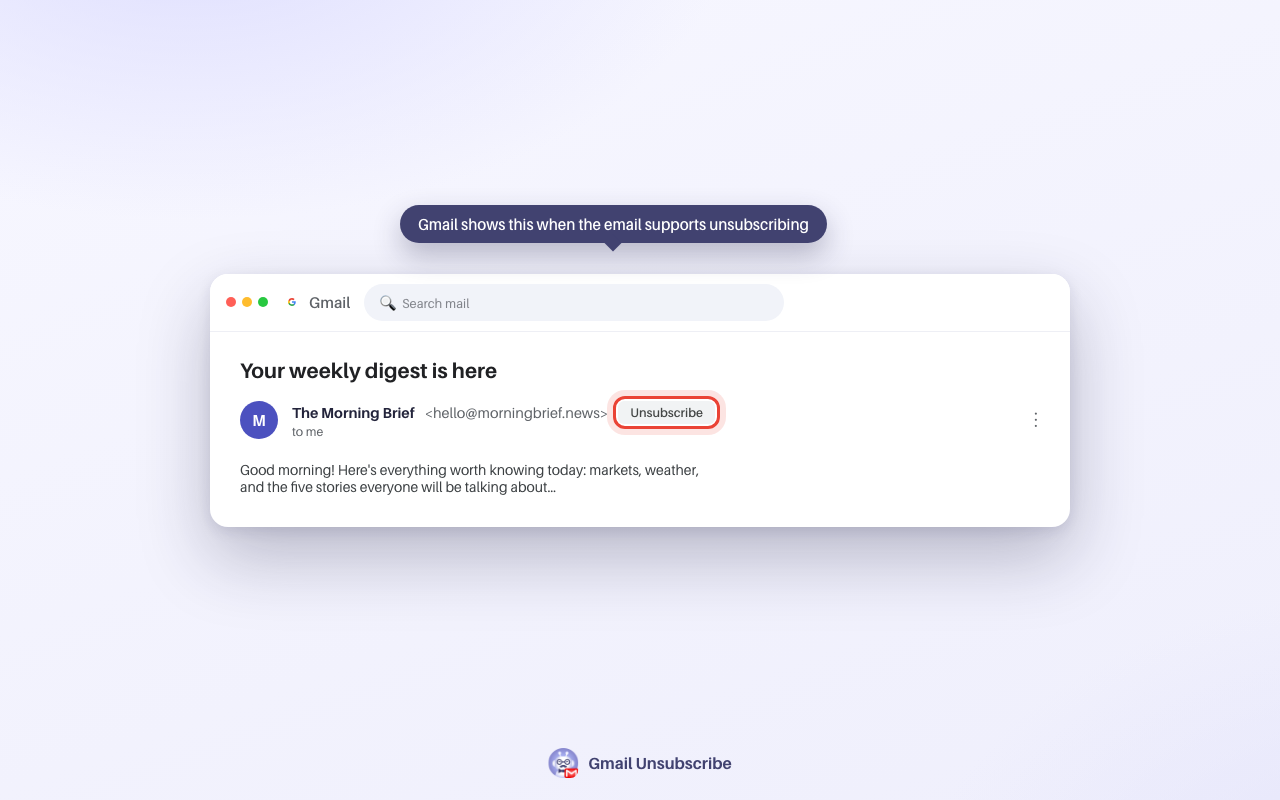
That link works because of a header the sender attaches to the message. If you want to know what Gmail is actually sending on your behalf, see what List-Unsubscribe is. The step-by-step desktop version lives in how to unsubscribe from emails in Gmail, and the phone versions are in the iPhone and Android guides.
Cancel several with Manage subscriptions
Gmail has a built-in view that lists your frequent senders with a cancel button on each row. In Gmail on the web, click More in the left menu, then Manage subscriptions. Google has been rolling it out gradually, so it may not be on your account yet.

It is a real improvement over hunting footers, with two limits worth knowing: it shows frequent senders rather than every list you are on, and one action can cover the lists Gmail associates with that sender. What it covers and what it misses is broken down in Gmail's Manage subscriptions view, explained.
Cancel subscriptions in bulk
Manual cancellation is fine for three senders. It stops being fine somewhere around thirty, which is where most neglected inboxes sit. Our average first scan finds about 15 subscription senders, and plenty of people find several times that.
Gmail Unsubscribe scans your Gmail inbox, groups the recurring senders, and sends each cancellation through that sender's own mechanism: an RFC 8058 one-click POST first, then a mailto request, then a GET link. Then it shows you the result for every sender, including the ones that failed. It does not file mail in Trash and call the subscription canceled, because that leaves you subscribed with a tidier inbox.
| Action | What it does | What it does not do |
|---|---|---|
| Cancel (unsubscribe) | Asks the sender to stop future messages | Remove mail you already received |
| Archive | Clears mail out of the inbox, keeps it searchable | Stop the next campaign |
| Delete | Moves mail to Trash, gone after 30 days | Stop the next campaign |
| Report spam | Sends the message to Spam and trains the filter | Take you off a legitimate mailing list |
| Block sender | Files that address in Spam from now on | Cancel anything with the sender |
Most cleanups need two of these, not one: cancel so the list stops refilling, then archive or delete the backlog. The bulk version of the second half is in how to mass unsubscribe from emails in Gmail and how to mass delete emails in Gmail.
Scan free, see every list you are still on, and cancel the ones you are done with without opening a single footer.
Add to Chrome, freeWhy some cancellations do not stick
A cancellation is a request to a stranger's mail system, and requests fail in ordinary ways.
- No working mechanism. About a third of the attempts we measure reach a sender that offers no usable unsubscribe path. Nothing on your end fixes that one.
- Separate lists. A retailer may run sale mail, product announcements, and a loyalty program as three lists. Canceling one leaves two.
- Slow processing. Some senders update their database on a schedule, so mail keeps coming for a few days.
- Dead links. Expired tokens and retired preference pages are common on older lists.
- It was never a subscription. Pure spam has no list to leave. Report it instead, and see is it safe to unsubscribe from emails for which senders to leave alone.
This is the reason we show per-sender results rather than a green checkmark for the batch. A failure you can see is a decision you can make. A failure you cannot see is just a surprise next Tuesday.
What not to cancel
An empty inbox is not the goal. A searchable one you trust is. Keep the mail that does a job:
- Receipts, invoices, and shipping notices, unless you have another copy.
- Security and account alerts from banks, password managers, and health providers.
- Newsletters you actually read, however often they arrive.
Watch the senders that mix categories. Canceling a bank's marketing list is sensible. Canceling the address that also sends fraud alerts is not, and some companies run both through one list. Read what you are canceling before you confirm. For newsletters specifically, how to block newsletter emails covers when blocking beats canceling.
Common questions
Does canceling delete the emails already in Gmail?
No. Canceling only changes future delivery. The backlog stays until you archive or delete it, which is why most cleanups are two steps.
Why do I still get emails after canceling?
Usually the sender needs a few days, runs a second list, or has no working mechanism at all. That last case covers roughly a third of attempts in our data.
Is canceling a subscription the same as unsending an email?
No. Undo Send recalls a message you sent, and only inside the cancellation period in your Gmail settings. See how to unsend an email in Gmail.